









Greetings from DISG Secretariat
Dear Readers,
Hello everyone, this is Masuo Kuremura, Chair of the DISG. March was a busy month for Japan-ASEAN relations, with many significant events taking place. First, we held the ASEAN Economic Resilience Symposium in Tokyo, attended by ASEAN Secretary-General Kao Kim Hourn and former Minister of Economy, Trade and Industry Hagiuda. The symposium focused on discussing which sectors and aspects of our respective industrial policies should be strengthened to make the Japan-ASEAN economy more resilient. On the day of the event, we confirmed our commitment to advancing industrial sophistication and enhancing economic resilience by leveraging each other’s strengths.
Additionally, a Japan-Singapore Summit was held on March 19. As 2026 marks the 60th anniversary of the establishment of diplomatic relations between Japan and Singapore, the two sides agreed to upgrade their bilateral relationship to a “Strategic Partnership.” They also identified five priority areas for cooperation—free trade, economic cooperation, digitalization, and security—and outlined plans to deepen collaboration in these fields. They confirmed that concrete cooperation would proceed in the areas of AI and semiconductors.
Furthermore, on March 31, Japanese Prime Minister Sanae Takaichi held talks with Indonesian President Prabowo in Tokyo. This was Mr. Prabowo’s first visit to Japan for bilateral talks since taking office in 2024. The two leaders discussed the situation in the Middle East and confirmed close coordination from the perspective of energy security. They also agreed to promote cooperation in the field of maritime security, with a specific country in mind that has been stepping up its activities in the South China Sea.
Prime Minister Takaichi noted, “As the international situation grows increasingly severe, cooperation with Indonesia, which is located at a strategic crossroads where the Indian Ocean and the Pacific Ocean meet, is extremely important for the realization of the ‘Free and Open Indo-Pacific (FOIP).’” President Prabowo stated, “In such an international situation, Indonesia and Japan must walk together,” and the two leaders agreed on further cooperation between Japan and Indonesia.
Through these various meetings, cooperation between Japan and ASEAN has progressed significantly in both multilateral and bilateral contexts. In this edition, we will continue to share how DISG promotes Japan-ASEAN cooperation through public-private partnerships.
Best regards,
Masuo Kuremura
DISG Task Force Chair
Executive Director, JETRO Singapore
Special Advisor to the Minister of Economy, Trade and Industry
Report on “Japan-Singapore Summit”
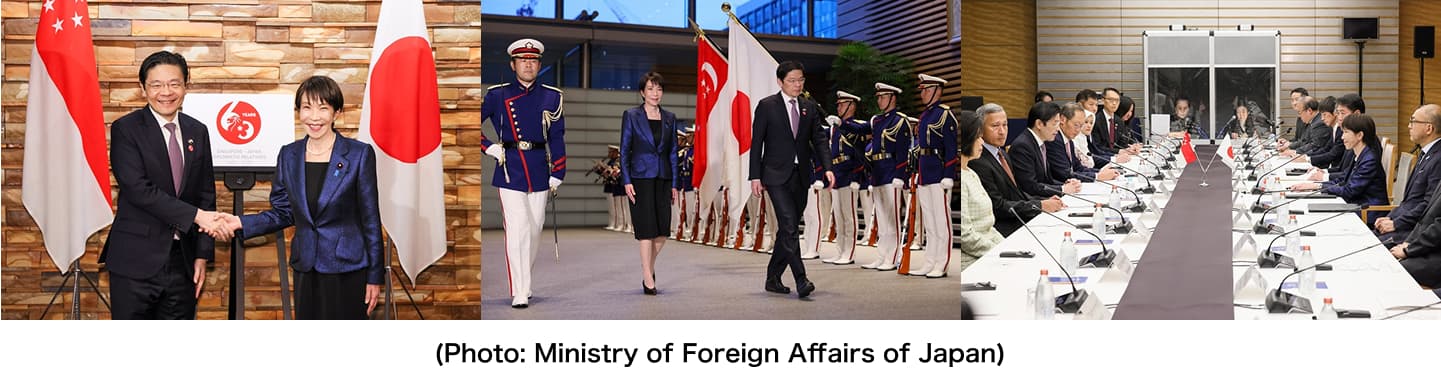
On March 18, 2026, Prime Minister Takaichi and Prime Minister Lawrence Wong during his visit to Japan to commemorate 60 years of diplomatic ties. The leaders officially upgraded the relationship to a "Strategic Partnership," establishing a new Joint Statement as a compass for the future. The new partnership is built on five key areas:
- Promotion of free trade and economic cooperation
- Digitalization and technology
- Security and defense
- Green transition and energy cooperation
- Partnership and exchange
● Economic Security
Amidst intensifying geopolitical competition, the leaders confirmed the significance of deepening cooperation to strengthen the autonomy and resilience of each nation. They pledged to advance concrete cooperation in areas of mutual interest, including AI, semiconductors, and quantum technology, as like-minded countries that uphold a rules-based international order.
● Future Outlook
As Singapore serves as the country coordinator for Japan within ASEAN and prepares for its 2027 ASEAN Chairmanship, both nations will work to synchronize the “Free and Open Indo-Pacific (FOIP)” and “ASEAN Outlook on the Indo-Pacific (AOIP)”. This alignment reinforces the partnership as a cornerstone for regional stability.
- Japan-Singapore Summit Meeting (English) (LINK)
Report on “Japan-Indonesia Summit”
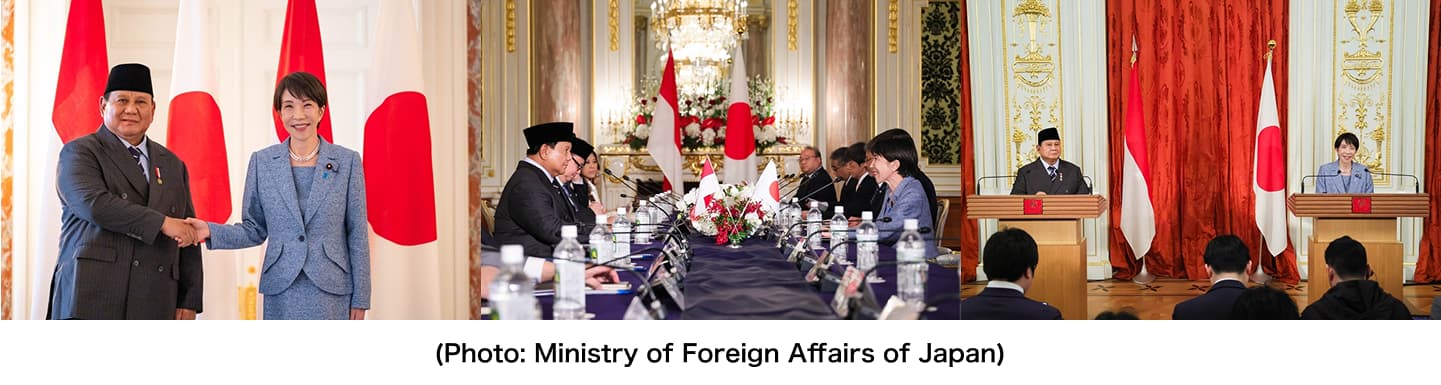
On March 31, 2026, Prime Minister Takaichi held a summit meeting with President Prabowo Subianto during his Official Visit to Japan. The leaders reaffirmed their commitment to the Comprehensive Strategic Partnership and the FOIP, focusing on the following three key areas.
● Bilateral Relations: Economic Area
To bolster Indonesia’s national resilience, Japan will provide financial support to improve the investment climate and collaborate on AI-driven industrial human resource development.
As maritime nations, both countries pledged to promote cooperation in the fisheries industry and enhance disaster management using Japanese satellite technology.
Furthermore, under the Asia Zero Emission Community (AZEC), the leaders agreed to advance geothermal, waste-to-energy, and civil nuclear cooperation. They also emphasized the need to strengthen supply chains for LNG and critical minerals to ensure regional energy security amidst global tensions.
● Bilateral Relations: Security Area
In the area of security, Prime Minister Takaichi pledged continued support for Indonesia’s armed forces through Official Security Assistance (OSA) and capacity-building for maritime law enforcement. Both leaders also welcomed the progress of discussions toward a Defense Cooperation Arrangement, following last year’s “2+2” meeting, to further deepen bilateral defense ties and ensure regional maritime safety.
● Regional and International Issues
The leaders engaged in an in-depth discussion on the Middle East and Iran, agreeing to work closely toward an early de-escalation to safeguard global energy stability. Prime Minister Takaichi also reaffirmed Japan’s commitment to a two-state solution for Palestine.
- Japan-Indonesia Summit Meeting (English) (LINK)
Report on “Symposium on Economic Resilience Strategy for Japan and ASEAN”
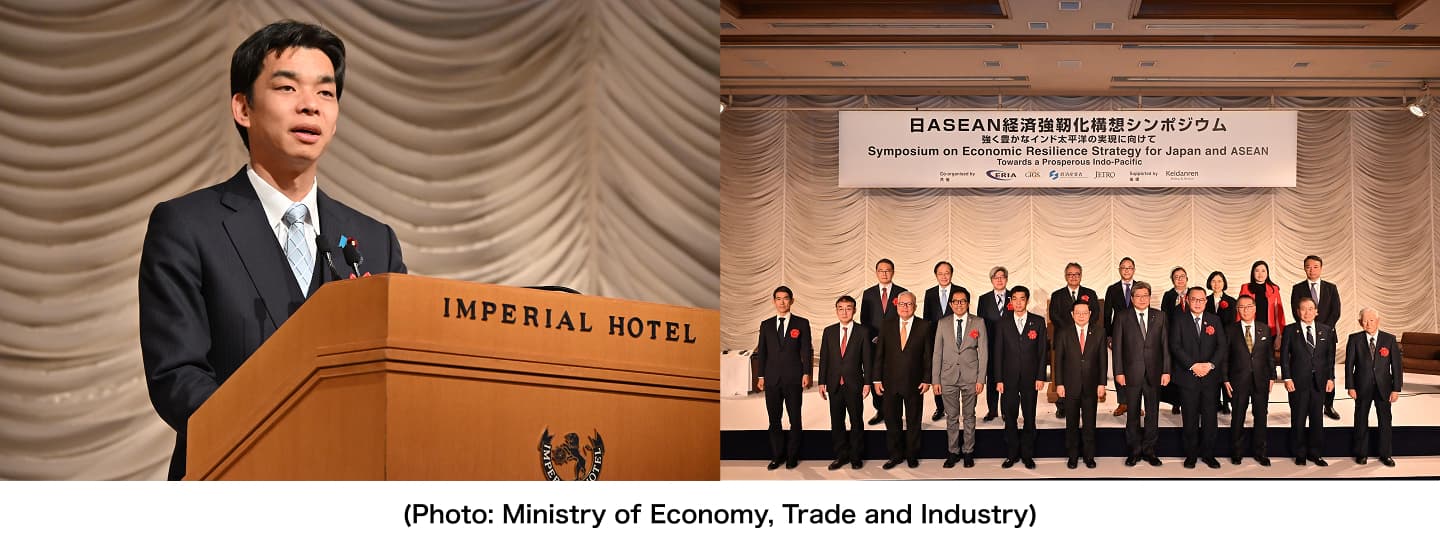
On March 6, 2026, the Ministry of Economy, Trade and Industry (METI), the Economic Research Institute for ASEAN and East Asia (ERIA), and other partners held a symposium to discuss directions for industrial cooperation to bolster the economic resilience of Japan and ASEAN. The event brought together government officials, industry leaders, and researchers to address cooperation strategies amidst an increasingly complex international landscape.
● Keynote speech by State Minister Ino
In his keynote speech, he expressed Japan’s commitment to enhancing the autonomy of key industries across ASEAN member states. He emphasized Japan's goal of fostering mutual growth by actively supporting Japanese companies in expanding private investment and business opportunities within the region.
● Panel Discussion
It focused on concrete resilience strategies, addressing both Japan-ASEAN collaboration and specific industrial and human resource cooperation between Japan and Indonesia. Experts from the National Institute of Advanced Industrial Science and Technology (AIST), METI, and the Indonesian Ministry of Industry engaged in an active exchange of views on industrial cooperation and human resource development based on the latest technical expertise.
- Symposium on Economic Resilience Strategy for Japan and ASEAN Held (English) (LINK)
Young Cambodian Political Leaders Visit State Minister Kunimitsu
On March 18, 2026, State Minister for Foreign Affairs Ayano Kunimitsu received a courtesy call from ten young Cambodian political leaders visiting Japan under the JENESYS 2025 exchange program. Representing a cross-section of the ruling party, opposition parties, and civil society, she welcomed the delegation and emphasized the program's role in supporting Cambodia's democratic development through cross-party dialogue. In response, the participants expressed their gratitude for Japan's ongoing cooperation and shared their desire to apply insights from Japan’s democratic framework to foster further growth and prosperity in their home country.
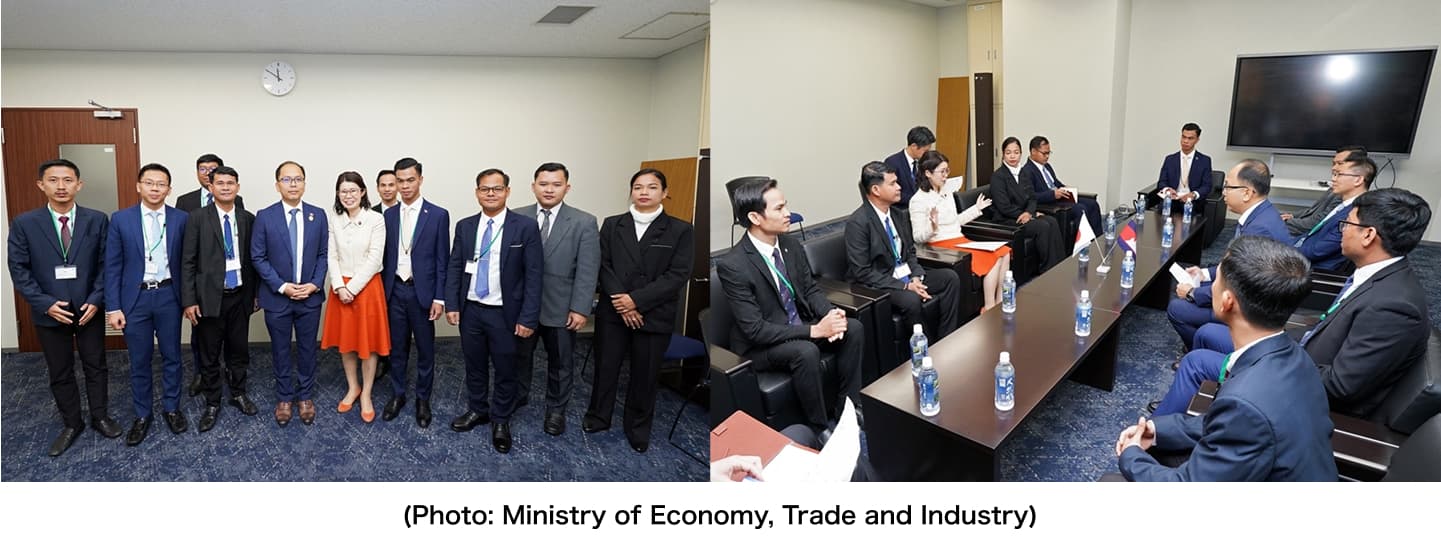
- Courtesy Call on State Minister for Foreign Affairs KUNIMITSU Ayano by the Delegation of Young Cambodian Political Leaders (English) (LINK)
Report on “Japan–Thailand Space Industry Forum”
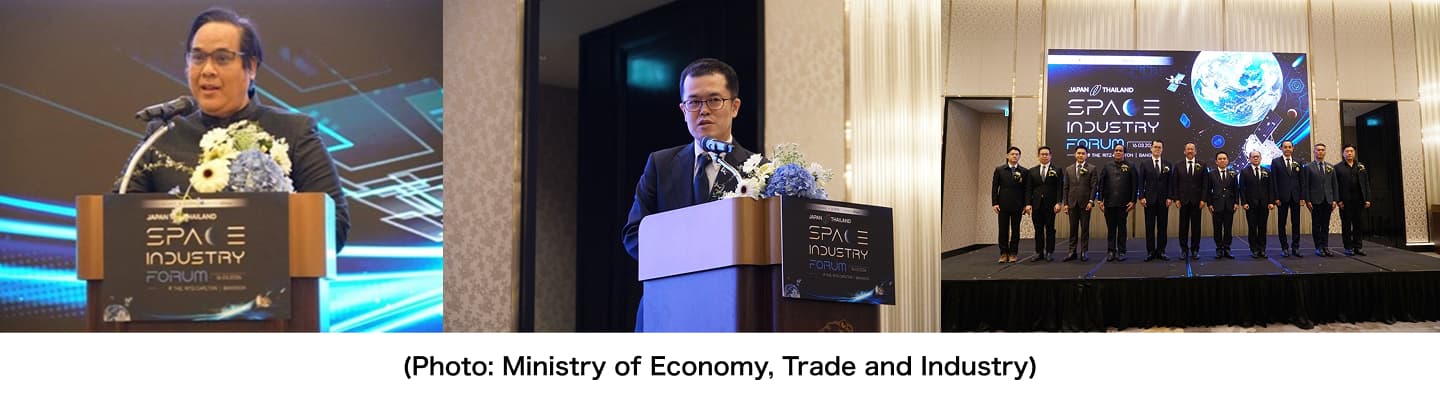
On March 16, 2026, the Japan–Thailand Space Industry Forum was held in Bangkok to foster public-private collaboration in the burgeoning space sector. With approximately 200 stakeholders in attendance, the forum highlighted the mutual benefits achieved through joint initiatives and expressed strong expectations for expanding new business opportunities and cooperative ventures between the two nations.
● Agreement on Joint Studies
Following the forum, representatives from Japan's METI and Thailand's MHESI and GISTDA held a meeting to deepen technical cooperation. They agreed to conduct joint studies on low-Earth-orbit (LEO) satellite constellations, which will serve as a vital foundation for enhancing daily life, industry, and security. This initiative will be carried out under a forthcoming Memorandum of Cooperation (MOC) involving JAXA and relevant industry partners, marking a significant step toward developing a robust space industry in both countries.
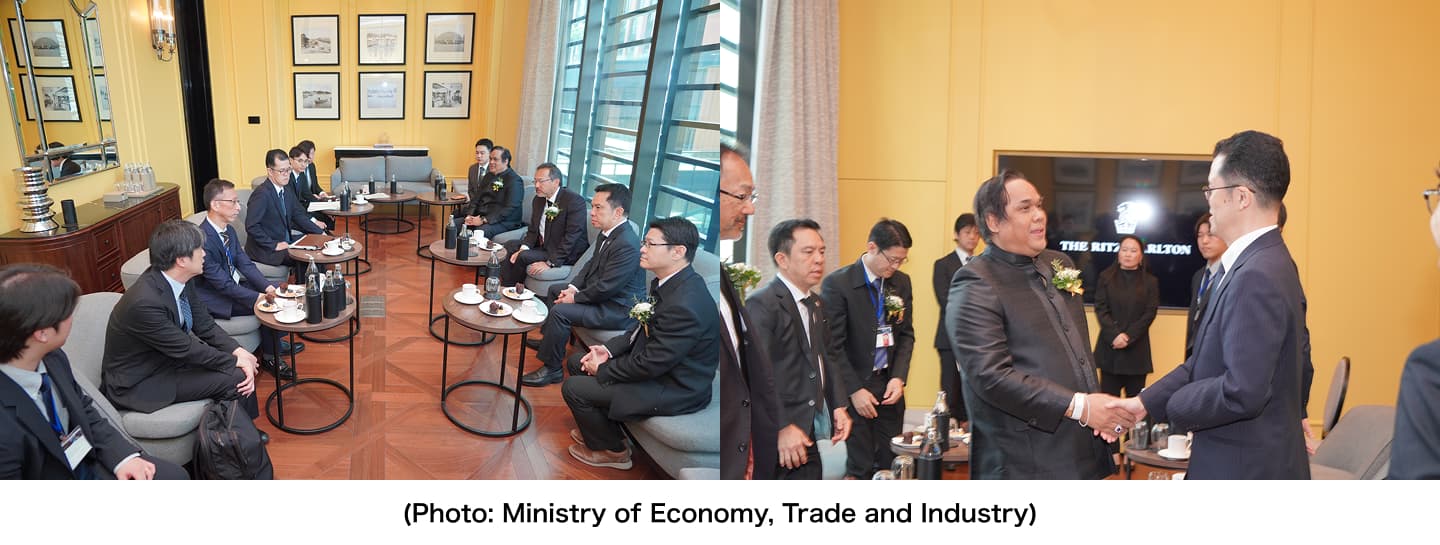
- Japan–Thailand Space Industry Forum Held (English) (LINK)
Editorial Note


